
RAW • REAL • UNFILTERED
Our Geothermal Hot Springs
Immerse yourself in geothermal hot springs in Alaska, where naturally heated, mineral-rich waters create a year-round place to unwind and reconnect with the surrounding wilderness.
Hot Springs Science
The Benefits
Body
Alleviates pain, improves flexibility and mobility, strengthens muscles, reduces swelling, and resolves muscle soreness.
Skin
Lends antifungal and antibacterial properties to the skin.
Heart
Assists in vasodilation, increases blood flow, enhances arterial flexibility and responsiveness, promotes new vessel growth, and boosts blood oxygen levels.
Mind
Mollifies emotional stress, improves sleep, and enhances short-term brain function.
Dive Deeper into the Health Benefits
Pain Relief
Chronic Pain
Soaking in mineral-rich warm water has been shown to alleviate chronic pain ameliorate chronic low-grade inflammation.
Sulfurous mineral water, in particular, can be absorbed through the skin. This has been shown to result in vasodilation and pain relief.
Furthermore, hot water immersion activates an acute inflammatory response by stimulating the mild release of inflammatory cytokines, which in turn activates a cascade of anti-inflammatory cytokines and increases Nitric Oxide levels in the blood. This results in an overall anti-inflammatory response within the body, thus relieving pain and pressure from within.
Mobility & Joint Pain
The buoyancy of the water, enhanced by the dissolved minerals within the water, opposes gravity and reduces the stress and application of weight to certain body parts. This helps alleviate pain and improves exercise ability during immersion.
Sore Muscles
The buoyancy that the minerals provide in the water helps ease mobility, which in turn helps increase flexibility and circulate lactic acid out of sore muscles.
Muscle Strenghtening
Water exerts force against body movements, which is why it takes more effort to move around while submerged in water. This promotes gentle exercise of your muscles, resulting in them becoming stronger.
Circulation and Oxygen Flow
Blood Flow
Warm water immersion alone assists in vasodilation, which increases blood flow. The sulfur content in the hot springs also promotes vasodilation, thus boosting the increase in blood flow throughout the body.
The calcium and sodium bicarbonate present in the hot springs, once absorbed, further enhances overall circulation and oxygen flow.
Blood Oxygen
Soaking in warm water increases blood oxygen levels and improves tissue oxygenation.
Vascular Health
Warm water immersion helps exercise proper vascular function by stimulating flow-mediated dilation of blood vessels, thus keeping blood vessels strong and responsive.
The dilation of the blood vessels helps reduce shear stress, which is the force that the blood exerts on the walls of blood vessels. Shear stress can cause damage to your blood vessels over time, which is why it’s important to engage in activities that promote blood vessel elasticity.
Notably, hydrogen sulfide has been shown to promote new vessel growth, assist in breaking apart in blood clots, and help in the prevention of atherosclerosis development.
Sweating It Out
It’s no secret that warm temperatures induce sweating, and our hot springs certainly are warm. Some studies have shown that sweating can help remove the following pollutants from your body:
Heavy Metals
Heavy metals can be neurotoxic when they accumulate in the body. Some researchers report that heavy metals in the blood appear to correspond with individuals that regularly come in contact with areas that are highly populated and/or areas with high traffic.
BPA
BPA is a plastic component that is commonly found in water bottles and food containers, and it can leach into your food and water over time.
BPA accumulation in the body has been linked to a plethora of adverse health conditions. These include, but are not limited to: endocrine disruption, gene dysregulation, metabolic disorders, immune dysfunction, and oxidative stress.
PCBs
PCBs are a group of man-made organic chemicals that were widely used in a variety of industrial and chemical applications prior to being banned in the 1970s. Despite them being banned over 50 years ago, PCBs still present a problem today. They are still present as a by-product of modern manufacturing processes, they take an incredibly long time to break down, and they tend to bioaccumulate in our bodies.
Furthermore, PCBs have been linked to multiple adverse health effects, including endocrine disruption and hypertension.
Skin Protection
Preventing Infections
The elevated levels of sulfur and salt lends antifungal and antibacterial properties that can prevent skin infections.
Improving Natural Defenses
The high sulfur and salt content of our hot springs can potentially have antioxidant effects, while the calcium content can have a protective effect by improving the skin’s natural defenses.
Protective Against Irritation
The high silica and calcium bicarbonate content helps inhibit mass cell histamine release, thus potentially preventing swelling and itchiness in individuals with sensitive skin.
Sleep and Brain Health
Sleep
Partial warm water submersion has been shown to improve sleep quantity and quality in elderly individuals.
Additionally, many of our guests who have used our hot springs have reported experiencing an exceptionally good night’s sleep afterwards.
Brain Health
Hydrogen sulfide (the precursor to sulfate) functions as a neuromodulator in the brain, and it reportedly may be involved in associative learning.
Furthermore, the increase in blood and tissue oxygen levels caused by warm water immersion leads to short-term enhanced brain function.
The Historical Use of Waters and Spas
The indigenous peoples of North America considered hot springs to be sacred places. They strongly believed in the miraculous healing powers of heat and mineral-rich waters, and hot springs were also employed as neutral grounds where warriors from any tribe could rest unbothered and recuperate from battle. The hot springs were fervently guarded, and were kept secret from European settlers for as long as possible.
Sleeping Child Hot Springs
Sleeping Child Hot Springs, located in the Rocky Mountains south of Missoula, Montana, was discovered by the Nez Perce Indians in the 1870s. Escaping from General Howard and a group of soldiers, Joseph of the Nez Perce guided his tribe out of the reservation, through the Lolo Pass, and into the Bitter Root Valley. Trying to avoid a fight, he split his tribe into smaller groups. One group ventured through Sleeping Child Creek, and left their infants by the hot springs to keep them safe from the impending battle. When the group returned, the infants were safe and peacefully sleeping. It was believed that the natural hot springs protected them.
Lolo Hot Springs
Not far from Sleeping Child Hot Springs, west of Missoula, Montana, resides Lolo Hot Springs. This hot springs was frequently used by the local indigenous people and described by Lewis and Clark in 1806 during their return trip east. According to Lewis’s June 29 diary entry, Lewis observed the indigenous people soaking in the hot springs for as long as they could bear it, and then ran and plunged themselves into an ice cold creek nearby. They would then return to the hot springs and repeat the behavior multiple times, always ending with soaking in the hot springs.
White Sulphur Springs
Near the Virginia-West Virginia border, there flows a mineral-rich hot springs by the name of White Sulphur Springs. The forests near the springs were originally home to Shawnee Indians. A small marsh containing salt deposits surrounding the hot springs would entice animals to come visit, and the Shawnee Indians would use this as their hunting grounds. There is also an Indian legend about these springs telling the tale of two young lovers who came here to hide from the scrutiny of their elders. A chief caught them and became furious. He shot two arrows, one killing the boy and one narrowly missing the girl. Where that second arrow hit the ground, a sulfur spring erupted. According to the legend, the lovers will be restored to life when the last drop of water from the spring has been drunk.
In 1778, a woman by the name of Mrs. Anderson was carried to White Sulphur Springs in an attempt to cure her rheumatism. As per Indian custom, a tree was cut down, hollowed out, and filled with spring water heated with hot stones. Mrs. Anderson routinely bathed in the water and drank from the spring. A few weeks later, the pain from the rheumatism was alleviated.
Warm Springs
Warm Springs of Georgia, known for its high flow rate and high bicarbonate concentration, was historically used by the local Creek Indians. Warm Springs was also visited by the Iroquois Indians, who made the ~1500km trek from modern day New York to arrive at “the land where the waters are warm.” The local indigenous people maintained a variety of trails throughout the area, which were used by all travelers. When settlers obtained the land via an 1825 treaty with the Lower Creek Indians, the settlers commercially developed the springs, and it eventually became the site of a polio treatment center.
Hot Springs, Arkansas
Hot Springs, Arkansas, has been estimated to have been used by humans for at least 10,000 years. Indigenous peoples referred to it as the “Valley of the Vapors,” and was revered as a sacred place that was home to the Great Spirit who brought forth the healing and warmth of Mother Earth. The Natchitoches Indians introduced the first European settler in the area to the hot springs for his health. The springs gained notoriety for its ability to cure ailments, and the first bathhouse was opened for visitors in 1830.
Thermopolis
Thermopolis in Wyoming is home to eight hot springs, including The Big Horn Spring, which is dubbed the largest mineral hot spring in the world. It has a flow rate of 120 liters per second and a temperature of 56 degrees Celsius. The Shoshone tribe referred to the springs as “healing waters” and Bah-gue-wana (“smoking waters”).
Calistoga
Calistoga, located approximately 120km north of modern day San Francisco, California, is home to several hot springs.This area was initially settled by the Southern, Central, and Western Pomo, the Western and Northern Wappo, and the Lake Miwok Indians. Each group spoke distinct languages and had unique cultures. They all gathered here to use the hot springs for soothing aches and pains. These Native people referred to this land as Tu-la-ha-lu-si, “the beautiful land.”
Harrison Hot Springs
About 80km east of Vancouver, Canada, there lies Harrison Hot Springs. The Native people in the area believed that the springs of boiling water were of supernatural origin, and they regarded it with awe and respect. It was believed that anyone who drank the water would be gifted with miraculous powers of endurance over others. According to some legends, the waters will boil for as long as there is illness in the land.
Early European settlers started using the hot springs in North America in the 1700s and 1800s. They eventually recognized the commercial value of the springs and developed many of them into traditional European resorts and spas. However, the United States did not establish any programs to support the spas. As a result, they were not nearly as successful as those in Europe. When public interest in the spas waned, many resorts closed, in spite of the hot springs’ proven benefits.
Spas in European Tradition
In Homeric times in Rome, baths were used for hygienic purposes– to cleanse and refresh. It was considered a part of aristocratic hospitality to offer washing facilities for guests. By the time of Hippocrates, the practice of soaking in a bath was considered to have health promoting properties. Baths were used therapeutically for the duration of the classical period. They were thought to aid in dietary nutrient absorption, and they were used for a variety of treatments. Baths were used for relieving chest and back pains in pneumonia sufferers, strengthening respiration, alleviating fatigue, soothing aching joints, treating headaches, and promoting urine secretion.
By the first century B.C in Rome, more elaborate suites of baths were constructed by wealthy individuals or town councils for the benefit of the entire community. They were employed as a hub for general cleansing, social interaction, exercise, and medical treatment. In the late second century B.C., a Greek physician by the name of Asclepiades passionately advocated for the use of baths for healthy individuals as well as those who suffered pains and illnesses. He believed that warm water soaks could treat skin issues, sinew disorders, gout, wounds, digestive disorders, wasting diseases, eye diseases, fevers, and also help people recover from surgery.
From the first century A.D. onwards, Methodist physicians became prominent advocates of using baths therapeutically. Soranus, the most famous Methodist physician, greatly valued baths for their use in relieving both physical and mental stress.
Meanwhile, a Roman architect and engineer by the name of Vitruvius, and a Roman naturalist popularly known as Pliny the Elder, were more interested in exploring the marvels of nature as they pertained to the exceptional properties of natural hot springs.They believed that there were different categories of natural hot springs, and they each had specific medicinal properties depending on their unique mineral content.
Some hot springs were transformed into lavish resorts, while others were more modestly established. Lavish or modest, natural springs were deemed as important amenities, and the Romans methodically developed them as they came upon them in the lands that they conquered.
Where Does Our Hot Springs Come From?
Chena Hot Springs is one of several hot springs located along a belt of moderate-temperature geothermal energy across central Alaska. The heat source powering the geothermal activity has not been fully established. However, scientists have determined that all of these hot springs are in or near granite plutons, which are balloons of solidified magma that have risen through the Earth’s crust. It has also been proposed that the radioactive decay of potassium (K), uranium (U) and thorium (Th) that have been found within the pluton is causing an unusually high regional geothermal gradient, thus contributing to the heat at Chena Hot Springs.
Chena Hot Springs is located at the border of a granite body. Deep, circulating geothermal waters rise up to the surface through cracks along the contact with surrounding rocks. Granite rock fractures or breaks very nicely in all directions, as opposed to layered sedimentary rock that just tends to break horizontally. This allows the hot water to quickly find its way to the surface from a great depth (~3000 feet).
Our hot springs was initially discovered in the early 1900s. In 1904, a U.S. Geological Survey team observed steam coming up from a valley along Chena River. They reasoned that the steam must be coming from a hot spring, but did not investigate further.
Two brothers, Robert and Thomas Swan, were the first two individuals in recent history to come upon the hot springs. They originally came to Alaska to chase gold mining opportunities, but Robert Swan suffered from rheumatoid arthritis and began seeking a place to heal. The brothers heard about the findings of the USGS team from the year prior, and they traveled there to investigate. One month later, in 1905, they found the hot springs.
The water was so hot (126 degrees Fahrenheit) that it was unbearable to soak in. To solve this problem, cold water from Monument Creek was diverted into the hot springs to make the temperature more bearable. This method of modulating the temperature of the hot springs is still being practiced today.
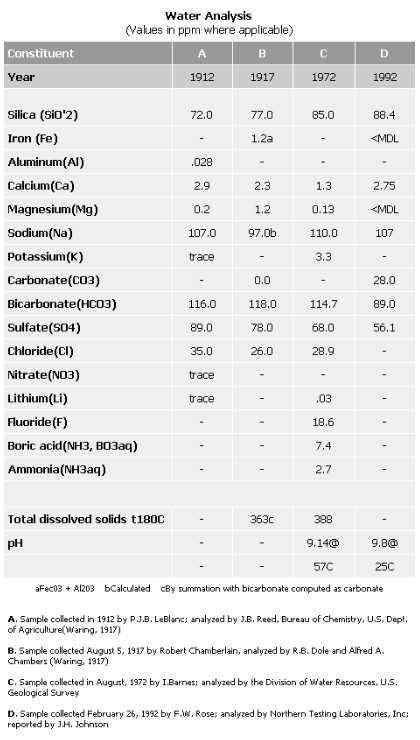
In 1912, Alaska’s delegate to Congress, James Wickersham, asked the U.S. Department of Agriculture to analyze the water from the springs. The results of that analysis, as well as the analyses that have been conducted since then, can be seen in the table below.
While Chena’s recorded history dates to the early 1900s, there is evidence that indigenous people used the water as well. The water boasts usage by people throughout Alaska, the Lower 48 and international visitors and dignitaries from every corner of the globe. The waters are timeless, but the resort began when weary gold miners discovered that soaking in the “oh-so-warm” waters helped their aching bodies.
References
Health Benefits
Vaidya, B. & Nakarmi, S. (2020). A Qualitative Study of Patients’ Beliefs and Perception on Medicinal Properties of Natural Hot Spring Bath for Musculoskeletal Problems. Journal of Environmental and Public Health, 2020(1). doi: 10.1155/2020/3694627
An, J., Lee, I., Yi, Y. (2019). The Thermal Effects of Water Immersion on Health Outcomes: An Integrative Review. International Journal of Environmental Research and Public Health, 16(7), 1280. doi: 10.3390/ijerph16071280
Harzy, T., Ghani, N., Nessrine, A., Bono, W., & Nejjari, C. (2009). Short- and long-term therapeutic effects of thermal mineral waters in knee osteoarthritis: a systematic review of randomized controlled trials. Clinical Rheumatology, 28, 501-507. https://doi.org/10.1007/s10067-009-1114-2
Aspen Valley Health (2022, April 7). The Health Benefits of Soaking in a Hot Spring. Aspen Valley Health. Retrieved January 22, 2026, from https://aspenvalleyhealth.org/healthy-journey/health-benefits-of-hot-springs/
Cacciapuoti, S., Luciano, M.A., Megna, M., Annunziata, M.C., Napolitano, M., Patruno, C., Scala, E., Colicchio, R., Pagliuca, C., Salvatore, P., Fabbrocini, G. (2020). The Role of Thermal Water in Chronic Skin Diseases Management: A Review of the Literature. Journal of Clinical Medicine, 9(9), 3047. doi: 10.3390/jcm9093047
Sheng, J., Qiu, W., Xu, B., Xu, H., Tang, C. (2016). Monitoring of heavy metal levels in the major rivers and in residents’ blood in Zhenjiang City, China, and assessment of heavy metal elimination via urine and sweat in humans. Environmental Science and Pollution Research International, 23(11), 11034-11045. doi: 10.1007/s11356-016-6287-z
Genuis, S.J., Beesoon, S., Birkholz, D., Lobo, R.A. (2011). Human Excretion of Bisphenol A: Blood, Urine, and Sweat (BUS) Study. Journal of Environmental and Public Health, 2012(1). doi:10.1155/2012/185731\
Genuis, S.J., Beesoon, S., & Birkholz, D. (2013). Biomonitoring and Elimination of Perfluorinated Compounds and Polychlorinated Biphenyls through Perspiration: Blood, Urine, and Sweat Study. International Scholarly Research Notices, 2013(1). https://doi.org/10.1155/2013/483832
May, S. & Mayes, F. (2024, January 11). Polychlorinated biphenyls (PCBs) were banned 45 years ago. Why are they still a problem? Department of Ecology State of Washington. Retrieved January 22, 2026, from https://ecology.wa.gov/blog/january-2024/polychlorinated-biphenyls-pcbs-were-banned-45-years-ago-why-are-they-still-a-problem
Hoekstra, S.P., Bishop, N.C., Faulkner, S.H., Bailey, S.J., & Leicht, C.A. (2018). Acute and chronic effects of hot water immersion on inflammation and metabolism in sedentary, overweight adults. Journal of Applied Physiology, 125(6), 2008-2018. https://doi.org/10.1152/japplphysiol.00407.2018
Carbajo, J.M., Maraver, F. (2017). Sulphurous Mineral Waters: New Applications for Health. Evidence-Based Complementary and Alternative Medicine. 2017(1). https://doi.org/10.1155/2017/8034084
Abe, K., Kimura, H. (1996). The possible role of hydrogen sulfide as an endogenous neuromodulator. The Journal of Neuroscience, 16(3), 1066-1071. doi: 10.1523/JNEUROSCI.16-03-01066.1996
The Historical Use of Waters and Spas
Lund, J.W. (1995). Historical impacts of geothermal resources on the people of North America. Geo-Heat Center Quarterly Bulletin Journal Issue, 4(16), 451-478
Jackson, R. (1990). Waters and Spas in the Classical World. Medical History, 34(S10), 1–13. doi:10.1017/S0025727300070952
Where Does Our Hot Springs Come From?
Kolker, A., Newberry, R., Larsen, J., Layer, P., Stepp, P. (2007). Geologic Setting of the Chena Hot Springs Geothermal System, Alaska. Stanford Geothermal Workshop: Proceedings, Thirty-Second Workshop on Geothermal Reservoir Engineering. Retrieved from https://pangea.stanford.edu/ERE/pdf/IGAstandard/SGW/2007/kolker.pdf
Erkan, K., Holdman, G., Blackwell, D., Benoit, W. (2007). Thermal Characteristics of the Chena Hot Springs Alaska Geothermal System. tanford Geothermal Workshop: Proceedings, Thirty-Second Workshop on Geothermal Reservoir Engineering. Retrieved from https://pangea.stanford.edu/ERE/pdf/IGAstandard/SGW/2007/erkan.pdf
Waring, G. (1917). Mineral Springs of Alaska. Department of the Interior, United States Geological Survey. pp 55-57.