
THE SCIENCE EXPLAINED
What is the Aurora Borealis?
The Aurora Borealis, also known as the Northern Lights, is a glowing, colorful display that appears when particles from the solar wind interact with molecules in Earth’s atmosphere near the planet’s magnetic poles. The journey of the aurorae begins with the sun.
The Journey
Solar Wind
The sun releases a steady stream of solar wind, which consists of plasma (electrically charged gas particles) and radiation (light waves). Solar wind can also be released in more abrupt, intense bursts called solar flares and coronal mass ejections (CMEs).
Guided by Magnetism
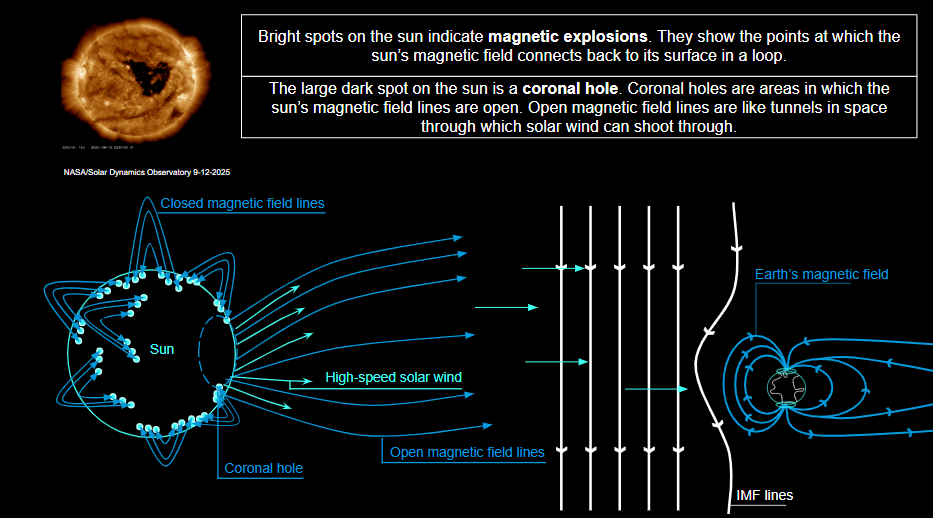
The solar wind and the Earth each have their own magnetic field. There is another magnetic field in between the Sun and the Earth, called the interplanetary magnetic field (IMF), which guides the solar wind towards Earth.
A Chain Reaction
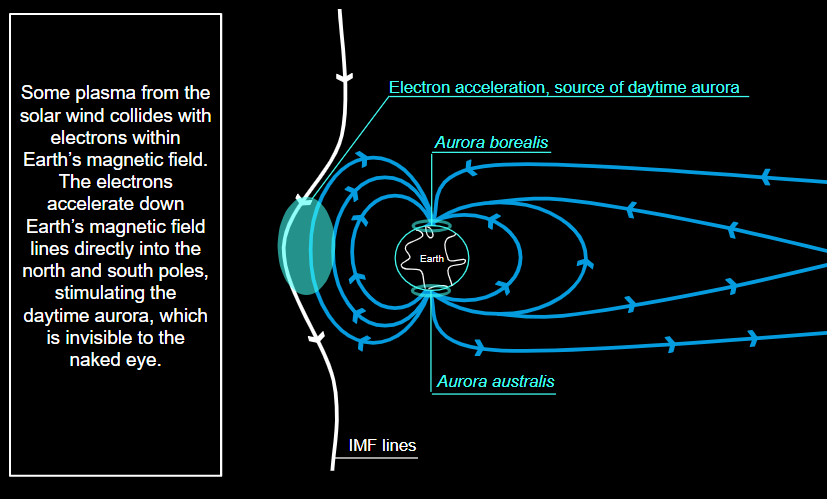
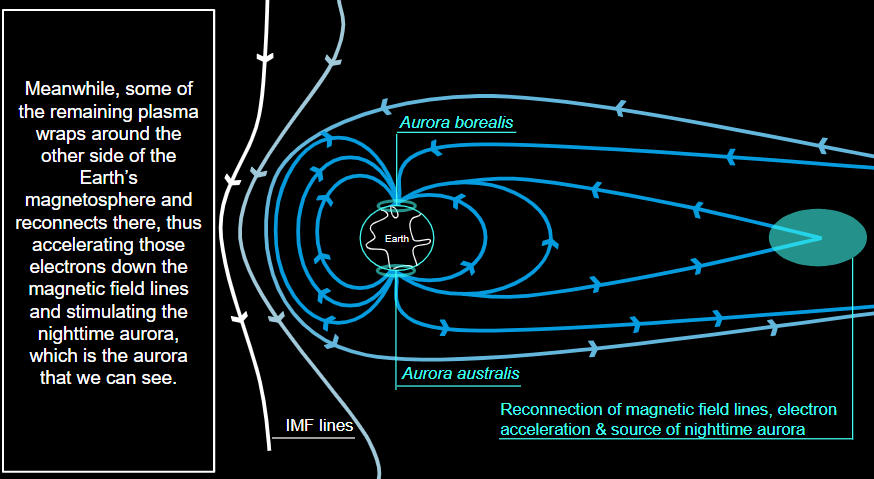
The solar wind collides with electrons in Earth’s magnetic field. These electrons then accelerate down into Earth's atmosphere, where they make impact with gas particles. As a result, the gas particles are charged with extra energy.
A Burst of Light
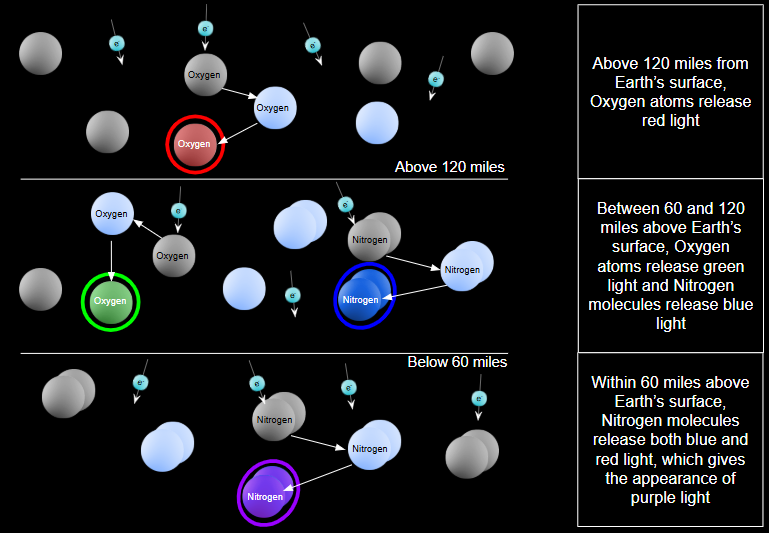
The gas particles release the extra energy as light. The color of light that is released is dependent upon the type of particle that is releasing it and its altitude.
Coronal Holes and Solar Wind
Daytime Aurora
Nighttime Aurora
Colors of the Aurora
Predicting Aurora Activity & Visibility
Here are some things you can keep an eye on to predict what kind of aurora you will see tonight!
Solar Flares & CMEs
Stronger solar flares and CMEs result in more intense auroral displays.
What Are They?
Solar flares are the light waves, specifically UV and X-ray waves, that are dispelled by the sun into interplanetary space. They are the electromagnetic signature of the event.
Coronal mass ejections (CMEs) are the charged gas particles, or the plasma, that are ejected with the solar flare.
How Are They Measured?
Solar flares are measured by X-ray satellites in space. Weaker solar flares have an X-ray flare class of A through C, and stronger solar flares have a class of M through X. Stronger solar flares result in stronger CMEs.
How Quickly Do They Reach Earth?
The energy from solar flares reaches Earth at the speed of light. The associated CMEs hit hours to days later, depending on the speed of the solar wind. The impact of a CME is what lights up the sky with intense auroral displays.
Dst
More negative Dst are indicative of stronger geomagnetic storms and more spectacular aurorae.
What Is It?
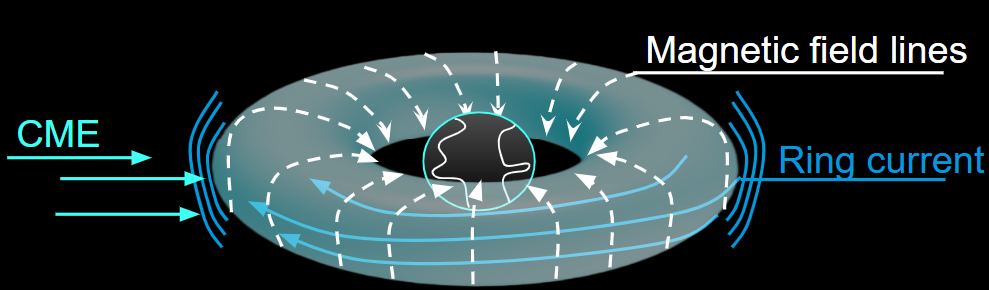
The Disturbance Time Index (Dst) is a measure of how much the ring current of Earth’s magnetosphere is jostled in response to a coronal mass ejection (CME).
How Is It Measured?
There are four geomagnetic observatories around Earth’s magnetic equator that measure geomagnetic disturbances in the ring current. More negative Dst values reflect higher amounts of energy stored in the Earth’s ring current, which is indicative of stronger geomagnetic storms.
Typical geomagnetic storms register Dst= -50nT (nanoTesla).
Kp
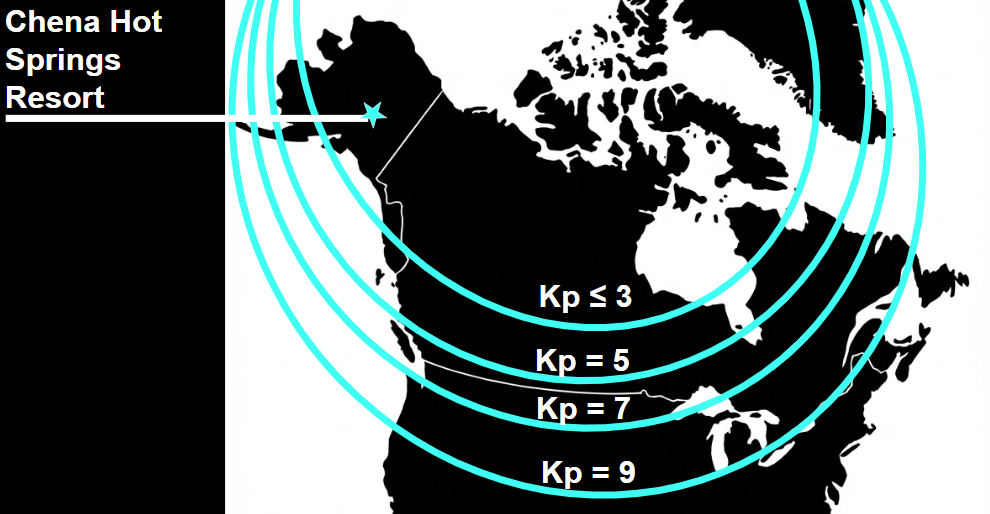
The aurora will be above Chena Hot Springs as long as the Kp value is at least 1.
What Is It?
The Planetary K-index (Kp) is a measure of the overall direction, strength, and change in the Earth’s magnetic field in response to solar events.
How Is It Measured?
There are 13 magnetometers across Earth’s surface that measure geomagnetic activity at those particular locations. The geomagnetic activity is given a K value ranging from 0 to 9, with higher values indicating higher activity. The average of those 13 values is calculated to be the Kp value.
What Do Higher Kp Values Mean?
The higher the Kp value, the more broadly the aurora can be seen across northern and southern latitudes.
Bz
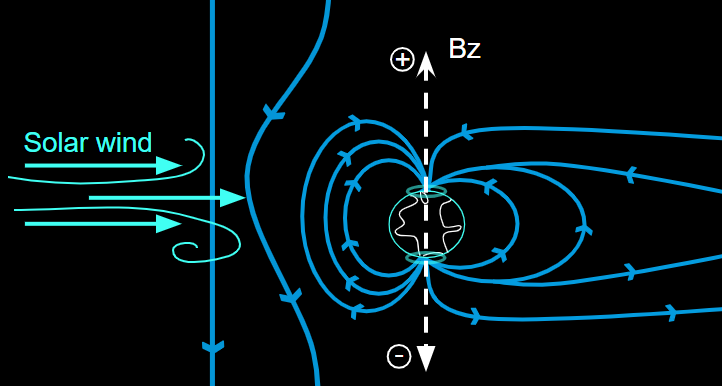
More negative Bz values correspond to a more active aurora show.
What Is It?
The Bz value is the north-south magnetic direction of the incoming solar wind as it spirals towards us.
How Is It Measured?
The direction of the solar wind’s magnetic field can change multiple times during its journey from the sun. The north/south direction of solar wind is detected by the DSCOVR satellite. More negative Bz values indicate a more southward pointing direction, which is more likely to be grabbed by Earth’s northward pointing magnetic field.
Time of the Year
Winter is the best season to see the aurora at Chena Hot Springs Resort.
Summer & Winter
During summer months, we are angled most directly towards the sun and receive constant sunlight. Even when the aurora is active, it is impossible to see during the summer.
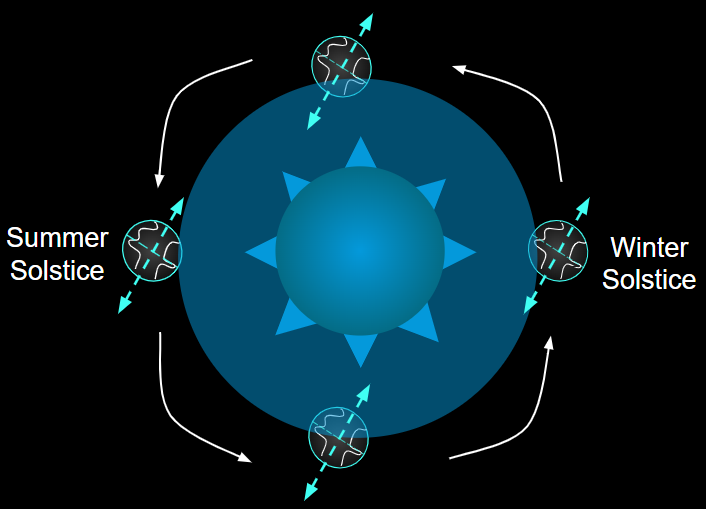
During winter months, we receive very little sunlight. The extending stretches of darkness between sunset and sunrise at Chena during the winter is ideal for aurora viewing.
Spring & Autumn
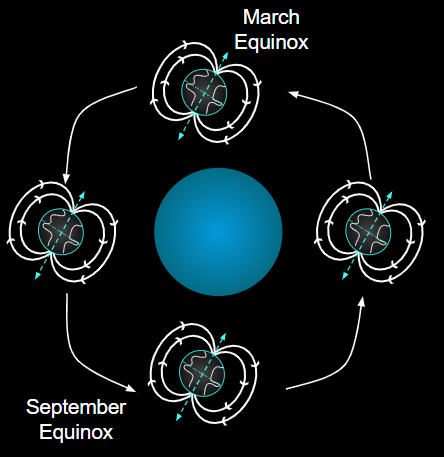
Solar wind can enter Earth’s magnetosphere more easily during the autumn and spring equinoxes. This is when the Earth is neither pointed towards nor away from the sun, thus making the sun and Earth’s magnetospheres more parallel to each other.
Solar Cycle
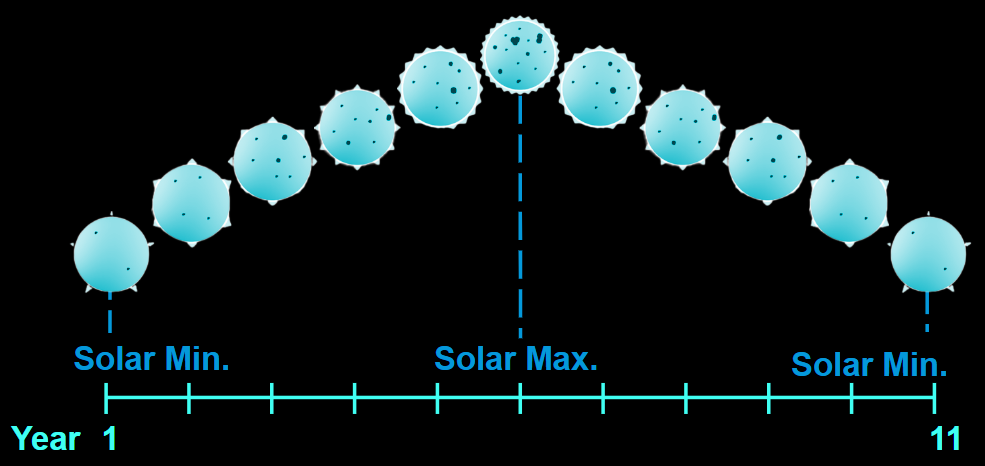
Solar activity gradually peaks and diminishes roughly every 11 years.
What Drives the Solar Cycle?
The solar cycle is driven by the gradual, constant rotation of the sun’s north and south magnetic poles. The sun’s magnetic north pole rotates to the south, and its magnetic south pole rotates to the north.
When Does Solar Activity Peak?
Solar activity peaks right before the sun’s magnetic poles complete their flip. This can be observed through the increase of sunspots. Sunspots are dark spots on the sun that are typically the origins of solar eruptions, including solar flares and coronal mass ejections (CMEs). Once the poles have completed their flip, solar activity becomes quiet again.
Where Are We In The Solar Cycle?
The sun’s most recent minimum was in December 2019, and its most recent maximum was in May 2024.
Cloud Cover
Cloud cover has the largest impact on aurora visibility at Chena Hot Springs.
Cloud Thickness
Blankets of thick clouds can completely mask the aurora. Thinner sheets of clouds may still allow the aurora to shine through, giving the clouds the appearance that they are glowing.
Partly & Mostly Cloudy Skies
Partly and mostly cloudy skies are not all bad. In fact, the spattering of clouds may even be advantageous for aurora viewing if the clouds block out bright moonlight.
Cloud Layers
Clouds sometimes form in layers. This means that even when it appears cloudy at ground level, there may be a break in between cloud layers at a higher altitude.
Predicting the Clouds
Predicting cloud cover is extremely difficult here at Chena. The nearest weather station is approximately 30 to 40 miles away. Therefore, local weather forecasts found on the internet and on weather apps are not entirely accurate. The best way to make predictions about cloud cover is to look up at the sky and see what the clouds are doing throughout the day.
Tips and Tricks
Look For Stars
If it is dark and clear enough to see the stars, then it is likely to be dark and clear enough to see the aurora.
Allow Time For Your Eyes to Adjust
Allow your eyes time to adjust to the darkness. The human eye needs approximately 30 to 45 minutes of continued darkness to fully adjust.
If you need to use lights or look at your phone screen, stick to using red lights and a red light filter for your phone. The long wavelength of red light does not interfere with darkness adaptation.
Averted Vision
Try an old astronomer’s technique called “averted vision” by diverting your gaze slightly away from the aurora. The part of your eye that is best at detecting faint light lies approximately 8° to 15° away from the part of your eye that detects your central vision.
Take a Photo
Take a photo of the sky. Cameras are better at “seeing” the aurora than you are. A camera lens can stay open for longer durations of time to allow more light to be captured, and it’s also better at detecting color in the dark.
Stay Vigilant
Most importantly, don’t lose hope! Stay observant throughout the night and be prepared to hunt the aurora for multiple nights. The exact timing of aurora activity and visibility is unpredictable. The more patient and diligent you are, the more likely it is that you will see it!
Shapes of the Aurora
Arcs
Long, thin, tall curve of light with a smooth lower border.
Bands
Long, thin, tall wave of light with an irregular lower border.
Rays
Tall shafts of light beaming upwards. Appears to wave and pulse when the aurora is more active.
Curtains
Rayed bands seen from a distance.
Coronae
Multiple rays converging to a crowning point straight up above.
Patchy and Pulsating (Diffuse)
Faint patches of pulsing light throughout the sky. This type of aurora is much dimmer than other forms of aurora and is incredibly rare.
Auroral Breakup
Sudden brightening and dancing of the aurora as it explodes into different rayed shapes.
Amazing Auroral Storms in History
Auroral storms are magnificent to behold, but they can have astounding consequences.
The 1859 Carrington Event
Arguably the most phenomenal auroral storm in history began on the night of August 28, 1859. This first wave of intense aurorae danced across the sky, alarming and fascinating observers around the globe. It was so strong that it was seen as far south as Jamaica and El Salvador in the northern hemisphere, and as far north as Australia and Chile in the southern hemisphere. Residents in Vermont mistook the red clouds as a sign of a fire, until the red clouds dissipated and green spires shot up in their place. Eyewitnesses around the world reported seeing brilliant aerial displays in the forms of rays, arcs, pulses, and diffuse glows. The most predominant color seen was red, but white, straw color, yellow, and orange colors were also widely reported.
Then, shortly before noon on September 1, 1859, british astronomers Richard Carrington and Richard Hodgson were each independently examining the large sunspots that had appeared on the surface of the sun. At approximately 11:20 AM, each astronomer simultaneously observed a sudden, intense solar flare erupt from one of the sunspots. Later that night, the second wave of intense auroral activity commenced. The spectacle was so fantastic that it drew crowds out into the streets. Many individuals saw the red skies and erroneously ascribed it to fires in surrounding towns. One observer compared what he saw in the sky to an undulating field of grain. Eyewitnesses in multiple other locations proclaimed that bright white clouds appeared in the dark of night, and these “clouds” shone so brightly that they could read by it. One group of campers in the Rocky Mountains even mistook this for daybreak and subsequently rose to prepare breakfast.
The sublime light show in the sky was not the only consequence of the auroral storm. There were also significant disturbances in the worldwide telegraph communication system, which caused a notable shift the public and the scientific community perspective of the aurora.
Newspapers from around North America and Europe reported that on the evening of August 28th, many telegraph lines became disrupted or completely nonfunctional. The following is a quote from The Illustrated London News, September 24, 1859:
“The French telegraph communications at Paris were greatly affected, and on interrupting the circuit of the conducting wire strong sparks were observed. The same thing occurred at the same time at all the telegraphic station in France” [sic].
More telegraphic disturbances were reported following the second massive auroral storm on September 2, 1859. These reports largely described how the telegraph lines were able to run on the aurora current instead of their usual galvanic battery. Operators from across the country declared that for about two hours, the telegraph wires functioned completely disconnected from the battery. The following is a conversation that occurred between a Boston operator and a Portland Operator:
Boston operator, (to Portland operator)– “Please cut off your battery entirely from the line for fifteen minutes.”
Portland operator– “Will do so. It is now disconnected.”
Boston– “Mine is disconnected, and we are working with the auroral current. How do you receive my writing?”
Portland– “Better than with our batteries on. Current comes and goes gradually.”
Boston– “My current is very strong at times, and we can work better without the batteries, as the Aurora seems to neutralize and augment our batteries alternately, making current too strong at times for our relay magnets. Suppose we work without batteries while we are affected by this trouble.”
Portland– “Very well. Shall I go ahead with business?”
Boston– “Yes. Go ahead.”
Remarkably, one Washington D.C. telegraph operator by the name of Frederick Royce was directly injured by the electrical current. The following is a quote from him:
“… During the display I was calling Richmond, and had one hand on the iron plate. Happening to lean towards the sounder, which is against the wall, my forehead grazed a ground-wire which runs down the wall near the sounder. Immediately, I received a very severe electric shock, which stunned me for an instant. An old man who was sitting facing me, and but a few feet distant, said that he saw a spark of fire jump from my forehead to the sounder…”
How Perspectives Were Changed
Before this event, popular explanations of the aurora included falling matter from erupting volcanoes and reflected light from icebergs or polar ice. Meanwhile, many scientists attributed the aurora to a higher altitude version of lightning, solely an Earth-bound phenomena. However, the strong association between the observed solar flares, the great auroral storm, and the telegraph line incidents opened up new possible perspectives for scientists and the public alike. Carrington himself stated that the connection between his observation of the solar flare and the subsequent geomagnetic storm may be notable, even though he would require more evidence before he was fully convinced of their interrelatedness. The public, however, did not require such evidence. The experience itself was enough to sway their opinions. The following are quotes from two newspapers at the time:
“A connection between the northern lights and forces of electricity and magnetism is now fully established” [Scientific American, October 15, 1859].
“Henceforth no one can be excused if he talks about the reflection from the polar seas of ice. We have practical evidence that the aurora is, or contains, the electrical fluid [current]” [Harper’s Weekly, October 1, 1859].
How Did the Aurora Cause Such a Disturbance?
It has to do with the interaction between the electrical currents in the aurora and the electrical currents in the Earth’s crust. The lithosphere, which consists of the Earth’s crust and uppermost solid mantle, is highly conductive. Electrical currents in the aurora can induce the ground currents in the Earth’s crust. During the Carrington Event, it was those induced currents that came up from the ground and caused the disturbances with the telegraph lines. If we had another event like that today, it would likely cause severe, permanent damage to our electrical grid and could cost up to $2.6 trillion and 2 years to fix. Many scientists predict that it’s only a matter of time before another Carrington-level event takes place.4,5 Even weaker geomagnetic storms could potentially be incredibly costly if transformer damage is concentrated in small regions with large populations.
The 1989 Quebec Storm
The Quebec Storm of March 1989 collapsed the Hydro-Quebec power grid. Over six million people lost electrical power for nine hours, resulting in an estimated economic cost of $13.2 billion. Furthermore, the storm caused irreversible damage to a generator step-up transformer at a nuclear station in New Jersey, which subsequently had to be removed from service.
The 2003 Halloween Storms
The Halloween Storms of October 2003 caused minor power grid disturbances in North America. Stronger ground magnetic field fluctuations rippled over Northern Europe, and Sweden experienced black out lasting less than an hour, affecting approximately fifty thousand customers. Even South Africa, which is located at roughly the same low latitude as Florida, suffered damages to twelve transformers, requiring their removal from service.
The Near Miss of July 2012
In July 2012, a terribly strong cluster of coronal mass ejections (CMEs) ripped through Earth’s orbit. Measurements indicate that these CMEs were at least as strong as those that occurred during the Carrington Event. Fortunately, Earth was at a different point of its orbit at the time. Instead of hitting Earth, the storm hit the STERO-A spacecraft, one of NASA’s satellites that collects data on space weather events. If this event occurred just one week earlier, Earth would’ve been hit and would’ve withstood significant damages to its electrical grid.
What Are We Doing to Protect Ourselves?
Aptly, certain protective measures are being implemented to safeguard us from such devastating effects of an auroral storm. NASA is currently working on a new satellite that will have much better predicting power for auroral storms than its current satellites. The current way of gathering spectral information is through a NASA satellite called IRIS, a single slit imaging spectrograph, which takes a single slit mask and scans the sun for solar events. The weakness of the single slit mask is that it can only measure one area of sun at a time.3 The new multi-slit solar explorer (MUSE), set to launch in 2027, will take a 35-slit mask, thus capturing a better time series of higher resolution images and spectral data of the solar atmosphere. This will enable it to diagnose conditions in the solar atmosphere over 35 times faster.
Steps can also be taken to harden the electrical grid here on Earth. In the time following the Quebec storm of 1989, the Canadian government has invested $1.2 billion installing numerous blocking capacitors to protect the Hydro-Quebec grid infrastructure.
Cultural and Spiritual Significance
“The dynamic interplay of ions and electrons that scientists observe and measure can be seen as the physical manifestation of what some cultures interpret as spiritual communication or cosmic harmony.”
-Belay Sitotaw Goshu & Muhammad Ridwan, 2024
Norse Mythology & Vikings
Vikings reportedly associated the northern lights with Norse mythology. According to Norse mythology, the aurora is a reflection of the armor worn by Valkyries, female warriors, as they lead fallen soldiers to Valhalla, the afterlife.
Greco-Roman Mythology
Greco-Roman mythology dictates that the aurora is the signature of Dawn riding in a chariot across the sky to announce the arrival of a new day to her siblings, the Sun and Moon.
Indigenous North American Cultures
Inuit and Iñupiat ( Northern Canada and Alaska)
In some Inuit and Iñupiat cultures, the northern lights are regarded as their ancestors playing a ball game of ball with a walrus skull.
As with many things in the sky, the Inuit and Iñupiat treat the northern lights with great respect as powerful, sentient beings.
Cree (Canada)
The Cree associate the aurora with the spirits of the deceased. These spirits have a comforting presence as they watch over their loved ones on Earth.
Algonquin (Eastern Canada)
For Algonquin tribes the aurora is the reflection of a fire lit by the Earth’s transformer, Nanabozho, to let his people know that he remembers them.
Menominee (Mid-West)
The Menominee of the present-day mid-west United States regard the aurora as light that emanates from torches carried by giants who go on fishing expeditions.
Northern Dene (Subarctic North America)
As with nearly all things in the Northern Dene universe, the northern lights have sentience or an animating life force. The northern lights are deeply respected, and customary laws prohibits whistling or staring at them. In some regions the northern lights are associated with large groups of caribou. The color and intensity of the aurora is also interpreted to forecast the weather.
European Cultures
Sami
The Sami interpret the aurora to be the spirits of the deceased. They see this as a bad omen, worthy of fear and respect. It’s forbidden to mock or whistle at the lights. The Sami fear that if the spirits notice them, the spirits will whisk them away into the sky.
Finnish
In Finnish culture, the aurora is referred to as “revontulet,” which translates to “fox fires”. The Finnish believe that the aurora is caused by the tails of arctic foxes brushing against the mountains and creating sparks as the foxes run across the skies.
Icelandic
In Icelandic tradition, the northern lights are believed to ease the pain of childbirth. However, if a pregnant woman were to see the northern lights, her child will be born cross-eyed.
Nordic
In Norway, the aurora is thought to be spirits in heaven waving to Earth.
Estonian
Estonians believe the aurora to be sleighs in heaven escorting wedding guests.
Danish
In Danish culture, the aurora comes from the flapping of swan wings, creating flurries of lightning when caught in the ice.
Swedish
Fishermen in Sweden view the aurora as a good omen since they believed it to be the reflection of giant schools of herring nearby.
English and Scottish
The aurora was not often seen in southern Europe. Some cultures consider it to be a bad omen when it does appear. At the beginning of the French Revolution, a bright red aurora was seen in England and Scotland. It’a believed that this was the foretelling of war and death.
The Scots in particular call the northern lights “merry dancers”, referring to angels falling in battle.
References & Links
The Journey
Steel, S. & Robinson, B. (2025, October 30). Space Weather Alert: Sunspots, Coronal Holes, and Space Storms. SETI Institute. Retrieved January 6, 2026, from https://www.seti.org/news/space-weather-alert-sunspots-coronal-holes-and-space-storms/
Logreira, D. & Thomas, V. (2025, February 4). Auroras. NASA. Retrieved January 6, 2026, from https://science.nasa.gov/sun/auroras/
Majower, N. (2017, January 12). What Is Space Weather? National Centers for Environmental Information. Retrieved January 6, 2026, from https://www.ncei.noaa.gov/news/what-is-space-weather
Majower, N. (n.d.). Aurora Tutorial. Space Weather Prediction Center. Retrieved January 6, 2026, from https://www.swpc.noaa.gov/content/aurora-tutorial
Predicting Aurora Activity and Visibility
Majower, N. (n.d.). What is the Solar Cycle? NOAA’s National Environmental Satellite, Data, and Information Service. Retrieved January 7, 2026, from https://www.nesdis.noaa.gov/about/k-12-education/optical-phenomena/what-the-solar-cycle#:~:text=The%20Short%20Answer,is%20a%20huge%20nuclear%20bomb
Upton, L., Biesecker, D., Gopalswamy, N., Ng, J. & Kim, K. (2020, September 15). How To Track The Solar Cycle. NASA’s Goddard Space Flight Center. Retrieved January 7, 2026, from https://svs.gsfc.nasa.gov/13715
Interrante, A. (2024, October 15). NASA, NOAA: Sun Reaches Maximum Phase in 11-Year Solar Cycle. NASA. Retrieved January 7, 2026, from https://science.nasa.gov/science-research/heliophysics/nasa-noaa-sun-reaches-maximum-phase-in-11-year-solar-cycle/
Majower, N. (n.d.). GOES X-Ray Flux. Space Weather Prediction Center. Retrieved Janurary 7, 2025, from https://www.spaceweather.gov/products/goes-x-ray-flux
Daglis, I.A., Thorne, R. M., Baumjohann, W. Orsini, S. (1999). The Terrestrial Ring Current: Origin, Fomration, and Decay. Reviews of Geophysics, 37(4), 407-438. https://agupubs.onlinelibrary.wiley.com/doi/epdf/10.1029/1999RG900009
Matzka, J., Stolle, C., Yamazaki, Y., Bronkalla, O., & Morschlauser, A. (2021). The Geomagnetic Kp Index and Derived Indices of Geomagnetic Activity. Space Weather, 19, 1-21. https://doi.org/10.1029/2020SW002641
Majower, N. (n.d.). Tips on Viewing The Aurora. Space Weather Prediction Center. Retrieved January 7, 2026, from https://www.swpc.noaa.gov/content/tips-viewing-aurora
Steel, S. & Robinson, B. (2025, October 30). Space Weather Alert: Sunspots, Coronal Holes, and Space Storms. SETI Institute. Retrieved January 6, 2026, from https://www.seti.org/news/space-weather-alert-sunspots-coronal-holes-and-space-storms/
Tilton, M. & McCullough, H. (n.d.). Discover Space Weather Data Portal. National Centers For Environmental Information. Retrieved January 7, 2026, from https://www.ngdc.noaa.gov/dscovr/portal/#/
Majower, N. (n.d.). Real Time Solar Wind. Space Weather Prediction Center. Retrieved January 7, 2026, from https://www.swpc.noaa.gov/products/real-time-solar-wind
Kalb, V., Kosar, B., Collado-Vega, Y., & Davidson, C. (2022). Aurora Detection From Nighttime Lights for Earth and Space Science Applications. Earth and Space Science, 10, 1-16. https://ntrs.nasa.gov/api/citations/20230005945/downloads/20230005945.pdf
Alexander, K.R. (2010). Information Processing: Retinal Adaptation. In Dartt, D. A. (Ed.), Encyclopedia of the Eye (pp. 379-386). Academic Press. https://doi.org/10.1016/B978-0-12-809324-5.01403-6
Kalloniatis, M., & Luu, C. (2005). Light and Dark Adaptation. In Kolb, H., Fernandez, E., Jones, B, et al. (Eds), Webvision: The Organization of the Retina and Visual System [Internet]. (pp. 1-13). Webvision. https://www.ncbi.nlm.nih.gov/books/NBK11525/
Alexander, R.G., Mintz, R.J., Custodio, P.J., Macknik, S.L., Alipasha, V., Venkatakrishnan, A., Gindina, S., Martinez-Conde, S. (2021). Gaze Mechanisms Enabling the Detection of Faint Stars in the Night Sky. European Journal of Neuroscience, 54(4), 5357-5367. https://doi.org/10.1111/ejn.15335
Shapes of the Aurora
Windridge, M. (2024, May 11). Bands, rays and arcs of green and purple. This is what causes the different shapes and colours of the aurora. BBC Sky at Night Magazine. Retrieved January 7, 2026, from https://www.skyatnightmagazine.com/space-science/what-causes-different-shapes-colours-aurora
Fukuda, Y., Kataoka, R., Uchida, H.A., Miyoshi, D.H., Shiokawa, K., Ebihara, Y., Whiter, D., Iwagami, N. & Seki, K. (2017). First evidence of patchy flickering aurora modulated by multi-ion electromagnetic ion cyclotron waves. Geophysical Research Letters, 44(9), 3963-3970. https://doi.org/10.1002/2017GL072956
Kataoka, R., Nishiyama, T., Tanaka, Y., Kadokura, A., Uchida, H., Ebihara, Y., Ejiri, M.K., Tomikawa, Y., Tsutsumi, M., Sato, K., Miuoshi, Y., Shiokawa, K., Kurita, S., Kasahara, Y., Ozaki, M., Hosokawa, K., Matsuda, S., Shinohara, I., Takashima, T., Sato, T., Mitani, T., Hori, T. & Hgashio, N. (2019). Transient ionization of the mesosphere during auroral breakup: Arase satellite and ground-based conjugate observations at Syowa Station. Earth, Planets and Space 71(9). https://doi.org/10.1186/s40623-019-0989-7
Amazing Auroral Storms in History
Kimball, D.S. (1960). A Study of the Aurora of 1859. Geophysical Institute of the University of Alaska, 6. https://scholarworks.alaska.edu/bitstream/handle/11122/3607/GI%20Reports%20109.pdf?sequence=1&isAllowed=y
Green, J.L., Boardsen, S., Odenwald, S., Humble, J., Pazamickas, K.A. (2005). Eyewitness Reports of the Great Auroral Storm of 1859. Advances in Space Research. https://ntrs.nasa.gov/api/citations/20050210157/downloads/20050210157.pdf
Cayley, F.R.S. (1873). Report of the Council to the Fifty-third Annual General Meeting. In Strangeways, J. (Ed.), Monthly Notices of the Royal Astronomical Society 33(4) (pp. 199). Royal Astronomical Society. https://babel.hathitrust.org/cgi/pt?id=mdp.39015065215124&view=1up&seq=225
Homeier, N. & Wei, L. (2013). Solar Storm Risk To The North American Electric Grid. Lloyd’s and the Atmospheric and Environmental Research, Inc. https://assets.lloyds.com/assets/pdf-solar-storm-risk-to-the-north-american-electric-grid/1/pdf-Solar-Storm-Risk-to-the-North-American-Electric-Grid.pdf
Phillips, T. (2014, July 22). Near Miss: The Solar Superstorm of July 2012. NASA. Retrieved January 7, 2026, from https://science.nasa.gov/science-research/planetary-science/23jul_superstorm/
Baker, D.N., Li, X., Pulkkinen, A., Ngwira, C.M., Mays, M.L., Galvin, A.B. & Simunac, K.D.C. (2013). A major solar eruptive event in July 2012: Defining extreme space weather scenarios. Space Weather, 11, 585-591. https://agupubs.onlinelibrary.wiley.com/doi/epdf/10.1002/swe.20097
Logreira, D. & Apodaca, D. (2025, June 5). MUSE. NASA. Retrieved January 7, 2026, from https://science.nasa.gov/mission/muse/
Logreira, D. & Lense, R. (2025, May 22). NASA’s MUSE Mission Passes Critical Design Review. NASA. Retrieved January 7, 2026, from https://science.nasa.gov/blogs/muse/2025/05/22/nasas-muse-mission-passes-critical-design-review/
Apodaca, D., Logreira, D., & Mahoney, E. (2024, August 24). NASA’s MUSE Mission Passes Key Milestone. NASA. Retrieved January 7, 2026, from https://science.nasa.gov/blogs/muse/2024/08/27/nasas-muse-mission-passes-key-milestone/
Cultural and Spiritual Significance
Purewal-Legha, A. (2023, December 1). Aurora Borealis– not BORE-alis! The Northern Lights’ Ancient Legends and Scientific Wonders. The Synapse: Intercollegiate science magazine, 38(1) 6-7. https://digitalcommons.denison.edu/cgi/viewcontent.cgi?article=1340&context=synapse
Goshu, B. S., & Muhammad Ridwan. (2024). Auroras: A Harmonious Blend of Natural Science and Human Culture. Lakhomi Journal Scientific Journal of Culture, 5(3), 151-164. https://doi.org/10.33258/lakhomi.v5i3.1197
Mashhood, H., & Nori, N. A. . (2025). Aurora Borealis: Scientific Mechanisms, Geomagnetic Influences, and Cultural Significance. Social Science Academic, 3(1), 77–84. https://doi.org/10.37680/ssa.v3i1.8195
John MacDonal. 2022. The Arctic Sky: Exploring the Inuit Universe. Iqaluit: Nunavut Research Institute. Retrieved from https://nacmedia.ca/product/the-arctic-sky
Cannon, Chris M. (2025). In the Footsteps of the Traveller: The Astronomy of Northern Dene. Manitoba: University of Manitoba Press. Retrieved from https://uofmpress.ca/books/in-the-footsteps-of-the-traveller