
RAW • REAL • UNFILTERED
Our Renewable Geothermal Energy
We are 100% off the grid. This is how we're doing it.
Geothermal Science
Our Projects
Makushin Geothermal Project
Follow the link below for information on the Makushin Geothermal Project, a joint venture between Chena Power and the Ounalashka Corporation to develop a 36MW geothermal power plant in Dutch Harbor, AK
Energy Projects
In addition to producing 100% of our electricity from renewable energy, we are also very interested in looking at alternative fuels for transportation and to replace propane.
Geothermal Power
Chena Hot Springs is the lowest temperature geothermal resource to be used for commercial power production in the world
Geothermal Exploration
Chena Hot Springs and the Department of Energy are jointly funding a $1.4 million exploration project designed to locate and characterize the geothermal resource underlying Chena Hot Springs.
How We Harness the Power of the Earth
What is Geothermal Energy?
Geothermal energy is a form of renewable energy that is more environmentally friendly than burning fossil fuels. It comes from the heat that is naturally produced in the center of the Earth. There are places in the world where some of that heat escapes to the surface, which is evident by the presence of natural hot springs. Geothermal power plants harness that thermal energy and convert it into electrical energy.
How We Accomplished it at Chena
The presence of our natural hot springs was our first clue that a significant amount of geothermal energy was not too far beneath our feet. Chena was completely without power for the majority of its history, but Bernie Karl sought to change things for the future.
We drilled down approximately 1,580 feet to reach 165-degree water. However, in order to convert the geothermal energy into electricity, we needed steam. Water doesn’t boil until it hits 212°F.
With the help of United Technologies from the U.S. Department of Energy, we were able to take on the challenge of developing the technology to produce power using our low temperatures. We became the only place in the world to create geothermal energy from 165-degree water!
What Makes Our System Special
Since our water is not hot enough to boil, we sought to find a liquid that has a lower boiling point. After careful research, we chose to use a chemical called R134A, which is a common refrigerant that has a boiling point of 140°F.
How it works: The warm 165°F water passes over pipes containing the R134A, which turns the R134A into steam. The R134A steam is the steam that turns the turbines to produce electricity. The steam is then channeled into the condenser unit, where it is cooled and condensed back into liquid, ready to start the cycle over again.
Our R134A is kept in a closed loop system to ensure that none of it leaks into the environment. The R134A we’re using today is the same R134A that we’ve been using for the past 10 years!
Future Goals
Our current geothermal power plant is the result of years of hard work and clever engineering. We got our first two condenser units up and running in 2005 and 2006, and we were able install a third, more efficient condenser unit in 2017. However, we are always looking for ways to improve.
Our geothermal energy currently provides 85% of our electricity. This means we have to rely on diesel generators to supplement the missing 15%. We hope to drill down another four to five thousand feet in hopes of reaching hotter water. If we can reach water that is even one degree hotter, that will give us enough of an extra boost to potentially close that 15% gap in energy.
How It Works
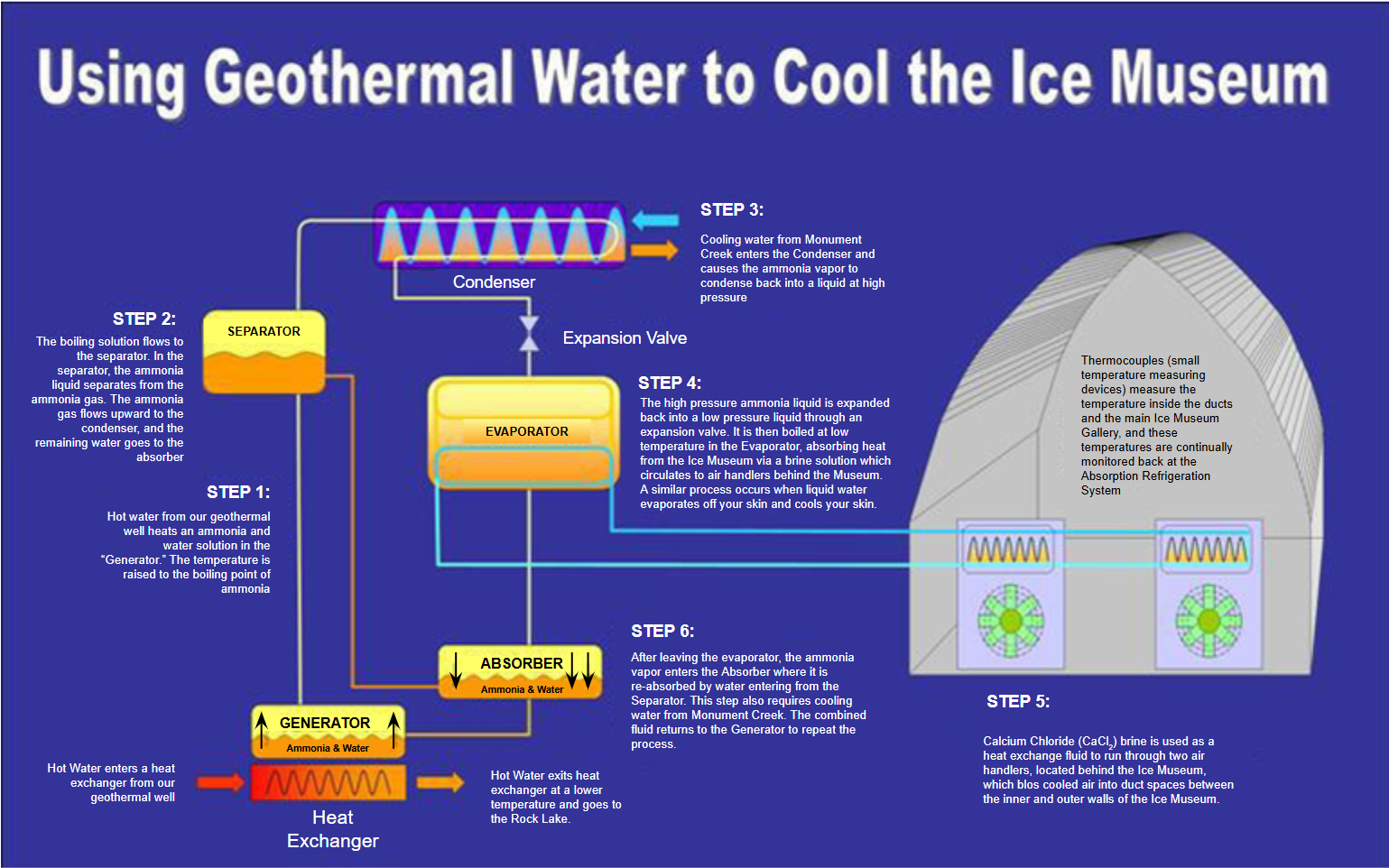
Using Hot Geothermal Water to Cool the Ice Musem
References
Erkan, K., Holdmann, G., Benoit, W., Blackwell, D. (2008). Understanding the Chena Hot Springs, Alaska, geothermal system using temperature and pressure data from exploration boreholes. Geothermics, 37(6), 565-585. https://doi.org/10.1016/j.geothermics.2008.09.001
Zarrouk, S.J., McLean, K. (2019). Chapter 2– Geothermal systems. Geothermal Well Test Analysis: Fundamentals, Applications and Advanced Techniques. pp 13-38. https://doi.org/10.1016/B978-0-12-814946-1.00002-5
Evers, J. (June 5, 2025). Core. National Geographic Education. Retrieved January 23, 2026, from https://education.nationalgeographic.org/resource/core/
Holdmann, G. (2007). The Chena Hot Springs 400kW Geothermal Power Plant: Experience Gained During the First Year of Operation. GRC Transactions, 31(2007), 515-520.